Dear Family and Friends,
MORE THAN ANIMALS
We can't imagine our family without these guys, Taco and Seismo.
They constantly bring smiles to our faces and take up too much
of our day with their priceless antics. Stan affectionately calls
them The Time Wasters.
We've worried if they'd survive the flights from Australia to Denver (never sedate your pet on flights); stewed over whether they'd understand that their six-week kenneling was necessary and not punishment; and purchased our home, in part, based on their needs and comfort. (One can't ask a cattle dog to live in a 5x10 run and expect them to thrive. They need an acre or two run in to maintain good health and stay out of trouble - meaning no digging!) We also turned down one lovely property because of the adjacent lot's HUGE prairie dog population. Local news has reported for two nights in a row of more bubonic plague in these rodents. (More on this later.) Hence, we looked at lots of properties over the past four weeks to find one we could afford
and fit everyone's needs. Only another pet lover would understand
all this. From the letters and comments we've received, there
are many of you who qualify! <grin>
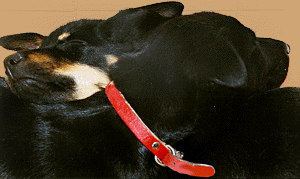
Even though this photo was taken when they were one year old, Seismo and Taco still cuddle like this. Not only do they depend on us, they need each other.
|
Seismo and Taco have earned their keep. They've dispatched literally
dozens of mice over the years, "entertained" Art Bell listeners
on Coast To Coast AM with their barking during Stan's interviews (Taco! Be quiet!), alerted us to poisonous snakes crawling up the side of our
house and lurking under shrubs in Australia, protected the property
since we weren't allowed firearms in OZ and thoughtfully provided
their parents with gray hairs when injured and laugh lines the
rest of the time. Yes, their feelings deserve to be considered
and their needs met. It's part of the human responsibility when
animals go home with you that first day.
DON'T LEAVE HOME WITHOUT THEM!
Every year during disasters, thousands of pets die or are seriously injured because people haven't planned ahead. Sometimes people must be temporarily housed in shelters. What becomes of Fifi and Fido? Most shelters do not accept pets unless they are an assistance animal. How many times have you seen people crying when interviewed after a tornado, hurricane or flood because their beloved pet perished when left behind?
Many times averting heartache is only a matter of preparation - something you would do for any two-legged family member. What are the plans for your pet during an emergency? Have you made arrangements for a friend or family member outside your immediate area to take over interim care? If you have notice of a possible hurricane or flood, have you checked to see if they can shelter in a kennel or checked into motels that allow pets if you have to evacuate?
EARS
Saturday, May 19th EARS (Emergency Animal Rescue Service) sponsored the third annual Animal Disaster Preparedness Day with the theme: Don't Leave Home Without Them. EARS has helped rescue many, many animals in more than 45 major
disasters over the last 12 years. Most recently, they participated
in animal rescues during the 2000 Montana wildfires and the 1999
Oklahoma tornadoes and Hurricane Floyd in North Carolina.
To help promote animal disaster prep, EARS is offering a free disaster preparedness information kit. Kits include a disaster
preparedness brochure, "shopping lists" for animal disaster supplies,
a poster, a handout on how to create a family disaster plan and
a starter set of identification collars for your animals. If you
would like these materials, send an email to info@uan.org or contact UAN, P.O. Box 188890, Sacramento, CA 95818.
Photo right: EARS volunteers evacuate an animal disaster victim following the 1997 Red River Flood in Grand Forks, North Dakota.
|
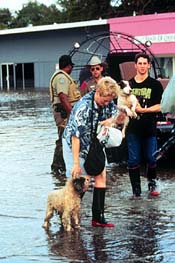
Photo from EARS
|
PET DISASTER PLANNING
Are you prepared to take care of your pet when disaster strikes?
NOW is the time to stock up on items he'll need. Disasters are stressful
enough without having to worry unnecessarily about your fish,
fowl, feathered or furry friends.
As Stan and I've mentioned previously, in order to cut down on
needed shipping room moving from Australia to America, we consumed
as many stored foods as possible. Instead of Taco and Seismo having
six months of dog food on hand, they now have zero. As soon as
the movers come and deposit our goods, restocking supplies will
be a priority.
DISASTER PREP FOR DOGS AND CATS
Below are handy shopping lists for you to use. The next time you
buy food or supplies for your animal, take this list with you.
Adjust the amounts, depending on the number of animals you have.
Don't put off doing what you should do now - it may just make
the difference between being able to keep your pet alive when
a disaster strikes.
The amount of suggested supplies to be stored are only for a short-term
disaster or if you must evacuate. Prudent planning dictates that
a three or six month supply would be much better. If you have
the room, buying these items on sale and in bulk will save you
big $$ in the long run.
FOOD
Store at least two weeks of the food your dog or cat is used to eating. During
an emergency is not the time to switch food brands or type.
Stan and I keep months of food on hand for Seismo and Taco and rotate it just like we
do ours. As a general rule, dry and canned cat or dog food keeps
18 months from date of manufacture. If your dog or cat eats canned
food, buy cans small enough to be used at one feeding. Electricity
may not be available to refrigerate leftovers. Be sure to include
a spoon for scooping and a can opener if the containers aren't
a pull tab variety. Store food in an airtight, water and rodent
proof container. Include a food bowl "just in case". |
Photo from EARS
|
WATER
Have enough drinking water to last at least two weeks for each dog and cat in your household. Like people,
animals can live a lot longer without food if they have adequate
H2O. Pets drink a lot more water than you might imagine. A medium
size dog will guzzle a gallon of water per day - just like humans.
Cats may consume a pint (two cups). Be sure to include extra if
paws send the water bowl flying.
Store water in a cool, dark location, and be sure to rotate it
every six months for freshness if using tap water. If tap water is not suitable for humans to drink, it's not fit
for animals either. Include a water bowl, "just in case".
SANITATION
Keep a pooper scooper in your disaster supplies for picking up after your dog or cat. Have a small litter box and at least a two week supply of litter. Plastic bags make for easy disposal and seals off odors.
Include with your disaster supplies a small container of soap for washing out your pet's food dish and paper towels for drying dishes and other cleanups. Depending on how traumatic the disaster, your pet might experience diarrhea. A small can of spray disinfectant is a good idea for little mishaps and to clean the pet's travel container.
|
Photo by CATerine
|
COLLAR AND TAG
A collar and I.D. tag should be kept on your dog and cat at all
times with an extra set in your disaster supplies. Choke collars
in disasters are not a good idea as your pet may accidentally
catch it on something and choke himself.
Keep a spare I.D. tag with your supplies. If you're housed somewhere
temporarily, you can write that phone number and address on the
extra tag. Include a sturdy leash with your disaster supplies.
If you think your pet might pull out of his collar, consider purchasing
a harness.
Continue
© Text and Graphics, 2001 Stan and Holly Deyo, except where otherwise
credited
|